
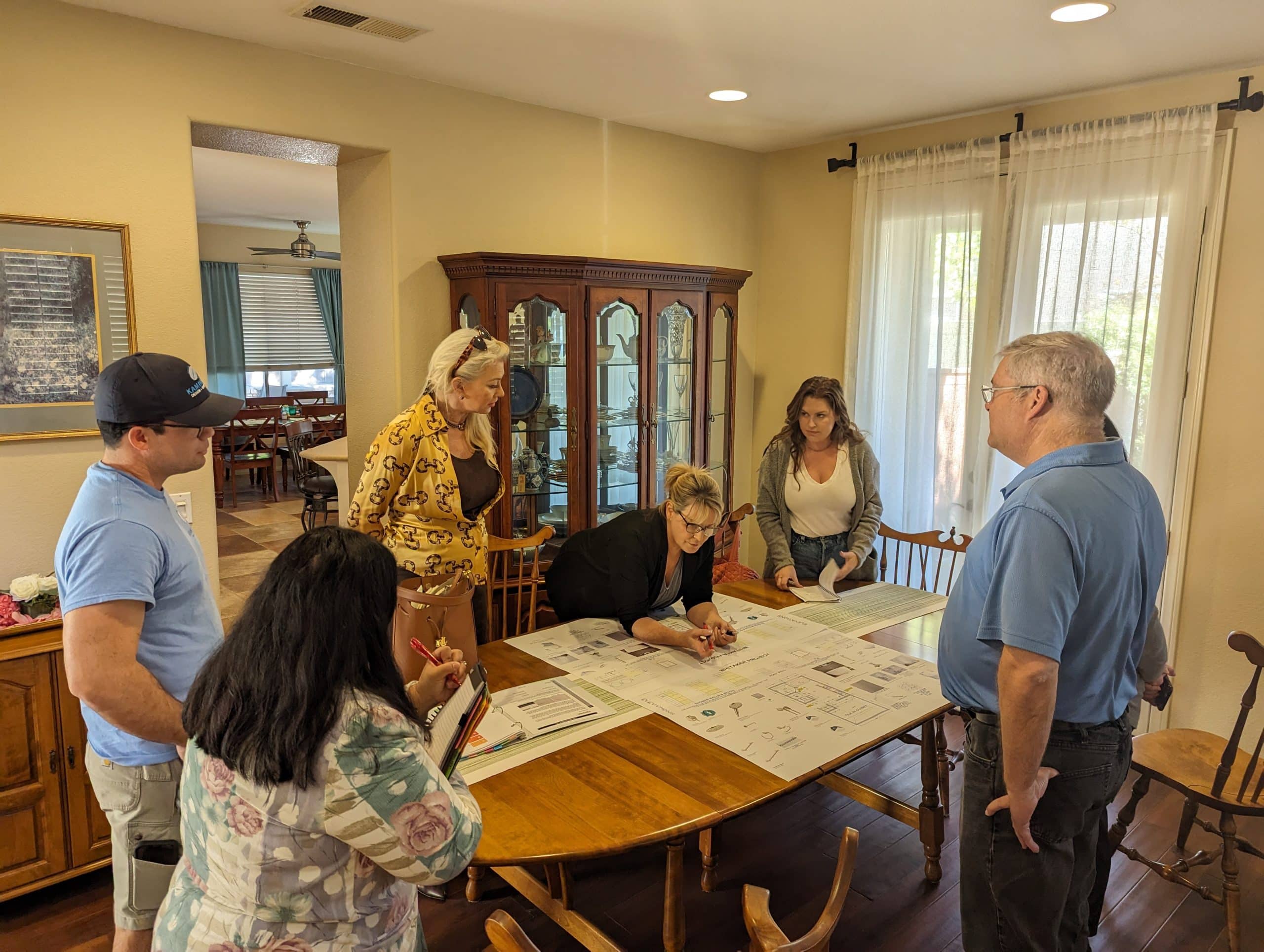
Why Your Designer and Contractor Should Be on The Same Team
When people picture what could go wrong with a remodel, they usually picture the final invoice. But that is not actually what worries homeowners most.
In a 2026 survey of 110 California homeowners actively planning a remodel, finding the right contractor was the single biggest fear at 37.27%, ahead of the budget at 30.91%. People are more afraid of hiring the wrong team than of what the project will cost. (You can read the full California Home Remodel Survey here.)
That fear is rational, and a lot of it traces back to one decision most homeowners make without thinking twice: hiring the design and the construction as two separate things.
Where the disconnect comes from
The traditional path looks reasonable on paper. You hire a designer or an architect first, they draw up the plans you fall in love with, and then you hand those plans to a contractor to build.
The problem is that those two parties are hired at different times, answer to different goals, and never share accountability for the same outcome. The designer is optimizing for the vision. The contractor is optimizing for what is buildable and what it costs. Nobody is responsible for making those two things agree before you have already paid for a design.
So you end up as the messenger, carrying questions and bad news back and forth between two companies who can each point at the other. When something does not line up, you are the one stuck in the middle.
This is also where the classic budget-versus-beauty fight starts. The design gets drawn without a builder pricing it in real time, so it comes back tens or even hundreds of thousands of dollars over what you planned to spend. Now you are paying to redesign, or cutting the things that made you excited in the first place.
What design-build actually changes
A design-build firm puts the designer and the builder on the same team, under one contract. If you want the full breakdown of how that model works, we cover it in What is a Design-Build Firm?. The short version matters here though: because the people designing the space and the people pricing and building it are talking to each other from day one, the budget conversation happens during design, not after it.
That single change removes the mid-project sticker shock. You find out what a feature costs while you can still decide whether you want it, instead of discovering it after the plans are locked.
One honest note on the architect question. Most kitchen and bathroom remodels are handled by in-house designers, not a licensed architect. You only need an architect or engineer when the project changes the structure of the house, such as moving a load-bearing wall or building an addition.
A typical design-build firm handles the everyday design work in-house, including space planning, interior design, architectural drafting, and construction documents, while bringing in a licensed architect or engineer only when the project scope truly calls for one. That way, you are not left hiring or coordinating those professionals on your own.
Design-build vs hiring separately: a side-by-side comparison
Here is how the two approaches stack up on the factors that actually shape a remodel, from who controls the budget to which projects each one suits best.
| Factor | Design-build (one team) | Designer and contractor hired separately |
|---|---|---|
| Cost control | The builder prices the design as it is created, so you see what the project scope would cost before the plans are final. Most mid-project budget surprises are removed. | Plans are drawn before a builder prices them, so a design can come back over budget and need reworking. You can competitively bid the build, which may help on simple, fully specified scopes. |
| Accountability | One team owns both the design and the build under a single contract. If something does not line up, it is theirs to fix. | Two companies with different goals. When design and construction conflict, each can point at the other and you are left deciding who is right. |
| Timeline | Design and pre-construction planning overlap, so material ordering and scheduling can start earlier and the overall project often moves faster. | Steps run in sequence: finish design, bid it out, sign a build contract, then start. Each hand-off between companies adds time. |
| Contract structure | A single contract covering design through construction. | Separate contracts for design and for construction, with scope you have to keep aligned between them. |
| Change-order risk | Lower. Constructability and pricing are checked during design, so fewer issues turn into change orders later. | Higher. Gaps between the drawings, field conditions, and real pricing tend to surface during construction as change orders. |
| Homeowner workload | One point of contact for design, materials, schedule, and payments. | You act as the go-between, managing two vendors and reconciling their plans, pricing, and timelines yourself. |
| Best-fit project types | Most kitchen, bathroom, whole-home, and addition projects, and homeowners who want one accountable team with less coordination on their plate. | Highly bespoke architectural builds led by a dedicated design firm, projects where you already have an architect you trust, or simple, well defined scopes you want to put out for competitive bid. |
For most kitchen, bathroom, whole-home, and addition projects an integrated team removes more friction than it creates. The right fit still depends on your specific situation, which is why the comparison matters before you hire anyone.
The real risk is trust, and the numbers prove it
The survey makes this even clearer when you sort the fear by income. At every level, the worry about hiring the wrong team beats the worry about money:
- $200k to $249k households: 38.2% feared finding a contractor most, versus 34.5% for budget.
- $250k to $499k households: 37.8% feared the contractor, while budget worry dropped to 24.4%.
- Households over $1 million: zero respondents named budget as their main concern. Their only worries were trust and design execution.
Read that last one again. The people with the most money to spend are not worried about the money at all. They are worried about whether the team can be trusted to deliver. That is exactly the risk that splitting your design and construction into two separate hires makes worse, and the risk an integrated team is built to remove.
The Tierrasanta couple below lived this. They interviewed six different contractors before choosing one team that handled both design and build. Most of the others wanted them to hire a separate designer first, and several pushed full custom cabinetry that would have blown the budget. Working with one team meant a semi-custom plan that respected what they wanted to spend, and creative solutions like running plumbing to the island that other contractors had told them could not be done.
See the full Tierrasanta kitchen remodel →
What it looks like when one team owns the whole project
These Point Loma homeowners came at it from a different angle. Both were working full time and simply did not want to manage two separate vendors on top of their jobs. With one team, the design, the materials, the schedule, and the payments all ran through a single point of contact. In their words, it was a one-stop shop, and that was the whole reason they chose it.
Two different households, two different priorities, the same conclusion: one accountable team took the coordination problem off their plate.
The specific benefits also shift depending on where you are in life, from millennials balancing budget and resale value to Gen X managing multigenerational households to boomers planning to age in place. We cover how the design-build approach fits each of those situations in Why San Diego Homeowners Choose Design-Build.
Is design-build always the right call?
No, and it is worth being straight about that. There are cases where hiring separately makes sense. If you already have an architect you trust and love working with, or your project is a highly bespoke architectural build where you want a dedicated design firm leading the vision, a separate arrangement can be the right fit.
For the large majority of kitchen, bathroom, and whole-home remodels, though, the coordination headache of running two companies usually outweighs the benefit. The thing to be careful about is the opposite failure: a firm that calls itself design-build but really bolts an independent designer onto a construction crew without the two ever working as one team. That gives you the disconnect with none of the upside.
Before you hire anyone, ask the right questions
The good news is that you can test for a real integrated team before you sign anything. A few specific questions will tell you whether a firm’s design and construction actually work as one unit, along with the basics every homeowner should confirm like licensing, insurance, and warranty. We walk through them in Questions to Ask Your San Diego Remodeling Firm.
This also matches what the survey found homeowners weigh most when choosing a company: reviews and reputation came first at 75.45%, well ahead of price at 67.27%. People want proof and a team they can trust, not the lowest bid.
The bottom line
Most homeowners walk into a remodel afraid of the wrong thing. The data says the real risk is not the budget, it is the team, and the way you structure that team shapes how the whole project goes. Keeping design and construction under one roof is one of the simplest ways to remove the finger-pointing, the budget surprises, and the feeling of being stuck in the middle that so many people fear before they ever begin.
If you are weighing your options for a San Diego remodel, that is the question worth answering first: will the people designing your home and the people building it actually be on the same team?
Frequently Asked Questions
What is the difference between design-build and hiring a designer and contractor separately?
A design-build firm handles both the design and the construction with one team under one contract, so the budget and the design are reconciled together before work begins. Hiring separately means you contract a designer first, then hand their plans to a contractor, and you act as the go-between for two companies with different priorities.
Is design-build cheaper than hiring separately?
Not necessarily cheaper, but more predictable. Because the people designing the project and the people pricing and building it work together from the start, the cost of each feature is known during design rather than discovered after the plans are finalized, which removes most mid-project budget surprises.
Do I need an architect for a remodel?
Usually only when the project changes the home’s structure, such as moving a load-bearing wall or building an addition. Most kitchen and bathroom remodels are handled by in-house designers. A good design-build firm keeps designers on staff and brings in an architect on demand when a project genuinely requires one.
When does hiring a designer and contractor separately make sense?
When you already have an architect or designer you trust and want to keep, or when your project is a highly bespoke architectural build where you want a dedicated design firm leading the vision. For most kitchen, bathroom, and whole-home remodels, an integrated team removes more headaches than it creates.
How do I know if a firm is truly design-build or just bolting the two together?
Ask whether design and construction are the same in-house team under one contract, who runs the project end to end, and how the budget and design are reconciled before construction. A genuine design-build firm answers these specifically; one that just subcontracts a designer onto a crew will be vague.

Kimberly Villa is the Operations Manager at Kaminskiy Design and Remodeling, with nearly two decades in the remodeling industry across both East Coast and Southern California markets. That day-to-day experience, from the first budget conversation to the final walkthrough, shapes the articles she writes for the Kaminskiy blog, helping homeowners make informed decisions before, during, and after a remodel. Before publication, each article is reviewed for accuracy by a Kaminskiy team member with relevant expertise, such as a licensed architect, certified designer, or project manager.