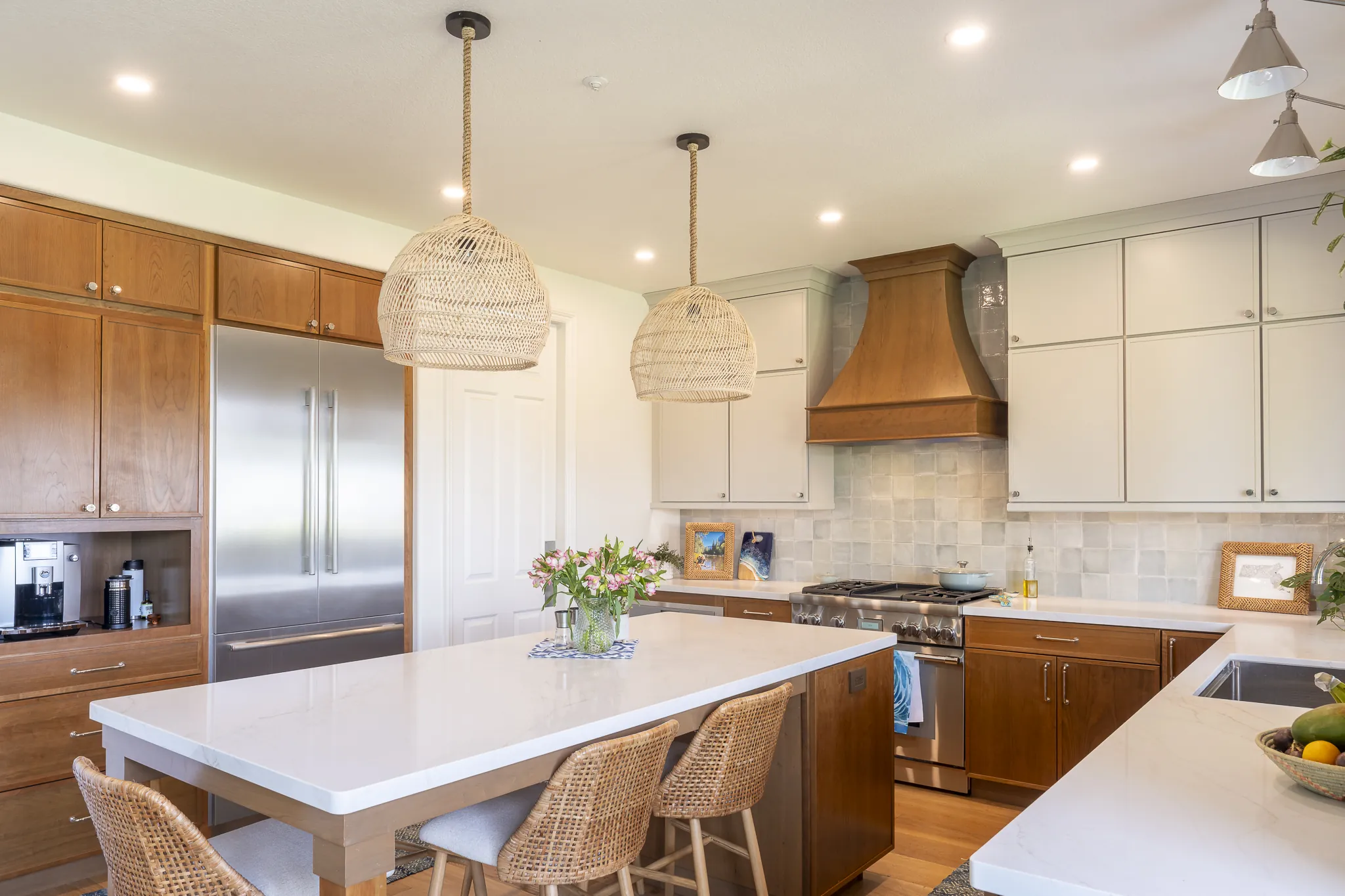


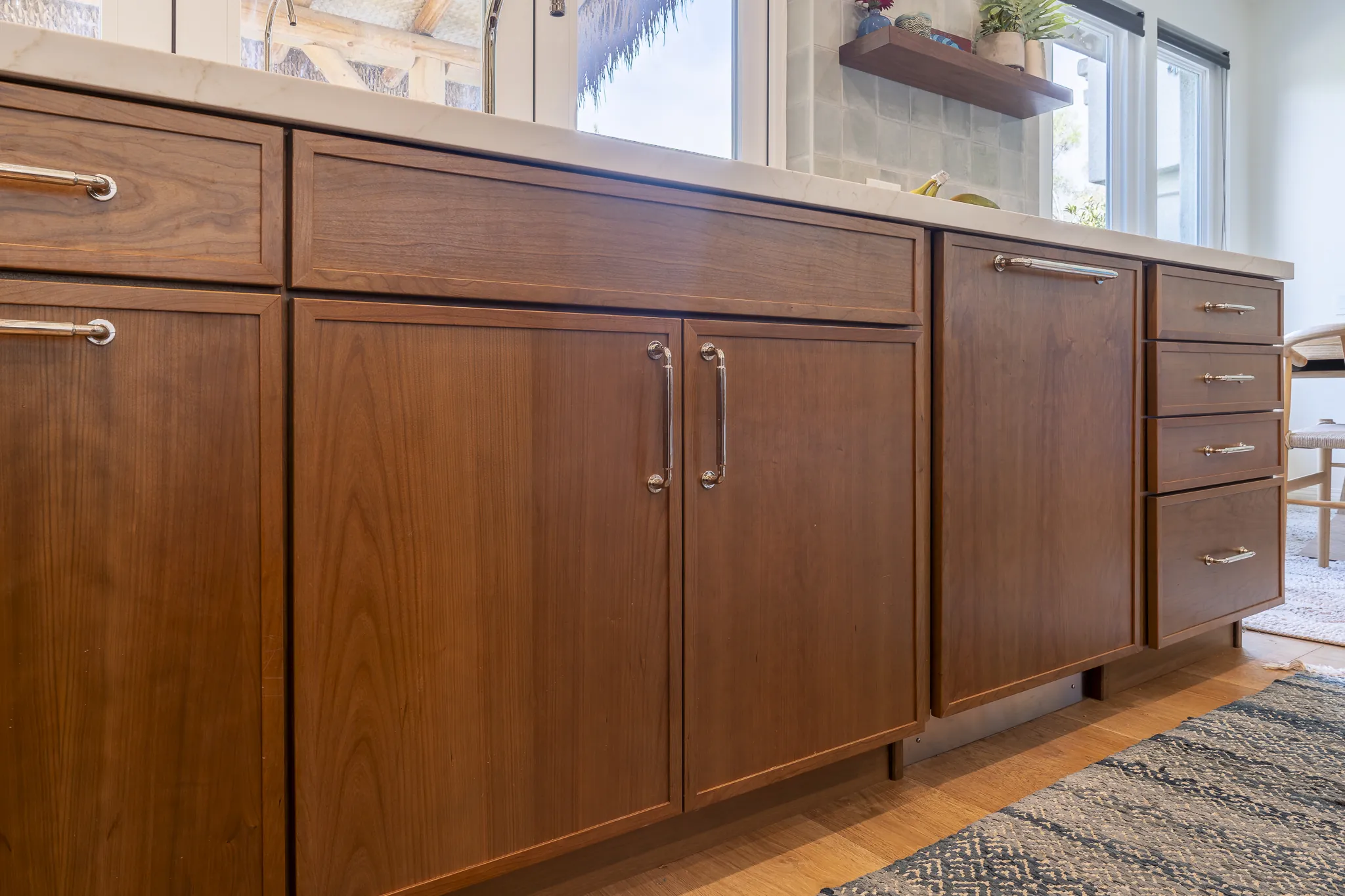


Kitchen cabinets in 2027 are wood again, and the wood is getting a little darker. Designers name white oak first, medium stains are back beside the light ones for the first time in years, and paint has moved to creamy whites with green as the accent. The appliances are disappearing behind matching panels, doors are replacing open shelves, the island gets its own color, and the inside of the cabinet, the drawers, the lighting and the pantry, is where the design effort goes. Behind the showroom, 2027 is also the year the tariff on imported cabinets is scheduled to double, which changes which lines are worth pricing.
This is the 2027 edition of our cabinet trends article. It draws on the National Kitchen & Bath Association's 2027 Kitchen Trends Report, the cabinet manufacturers' own sales and trend data, federal trade statistics and the written kitchen inquiries in our own records. Where a number people quote for 2027 is not actually public, we say so instead of repeating it. For the whole room, layouts, countertops and cooking included, see our kitchen remodeling trends guide for 2027.
The seven cabinet trends for 2027, in one line each:
- Natural wood, white oak first: wood you can see the grain in, on the island, the base cabinets or one tall wall.
- Medium stains return: warm mid-tones beside the light oaks, after fifteen years of white, gray and pale.
- Creamy white and green: soft off-whites for the painted run, green as the accent, usually on the island.
- Hidden appliances: panels on the refrigerator and dishwasher, appliance garages, the microwave in a drawer.
- Doors, not open shelves: enclosed storage to the ceiling, with a shelf or two kept for display.
- The inside of the box: deep drawers, pull-outs, lighting inside and under the cabinets, a pantry wall.
- Matte, slim and quiet: flat-panel and slim-rail doors, matte finishes, hardware that does not shout.
Wood is back, and medium tones are back with it
The NKBA's 2027 Kitchen Trends Report, from a survey of 830 kitchen professionals released in October 2026, titles its cabinet finding "Wood, Not Painted, Wins." 34% of designers expect natural-finish cabinets to be popular, 32% favor light tones and 32% medium tones, and white oak is the wood of choice for 49%, close to the 51% of a year earlier. The year before, the same survey reported wood grain overtaking painted cabinets as the finish growing in popularity.
The manufacturers see it too. MasterBrand, which describes itself as the largest residential cabinet manufacturer in North America, reported in its 2027 trends release, a survey of more than 2,000 of its own designers and dealers, that "for the first time in 15 years, medium stains are breaking into the top spot alongside light wood stains and creamy off-whites," and named a warm mid-tone stain its finish of the year. Minwax chose a light wash called Pickled Oak as its 2027 color. Read together: the pale, natural oak of the last few years stays, and a warmer, slightly deeper wood has joined it.

One thing the trade data corrects. White oak's popularity has not made the lumber scarce: the hardwood industry's price reporting in August 2026 had white oak at its lowest in at least two and a half years, and walnut, not oak, is the species with a real supply squeeze. What you pay for in an oak kitchen is the cut, the veneer matching and the finishing, not a shortage. Rift-cut oak, with its straight, even grain, is the look most of our clients mean when they say white oak, and a clear matte finish is what keeps it pale.
Where the wood goes matters as much as which wood. In our kitchens it is rarely everywhere: an oak island with a painted perimeter, wood base cabinets under soft white uppers, or one tall wall of wood that reads like furniture. A full room of one wood on a wood floor is the version that dates.
Door styles: slim rails, flat panels and the shaker that never left
Here is the honest state of the data. The NKBA's 2027 report covers door styles, but those figures are for members and are not public; any site quoting a 2027 percentage for shaker or slab doors is repeating the 2026 report, in which 69% of professionals named the flat, slab door as gaining popularity. The cabinet manufacturers' association keeps its style survey for members as well. Trade reporting in 2026 described frameless, full-access construction as running about even with traditional face-frame cabinets among American makers, with inset doors holding steady at the high end.
What we see at the design table matches that. Three doors cover nearly every kitchen we draw:
- The slim-rail shaker. The same five-piece door with a narrower frame. It reads cleaner than the classic shaker and still suits a ranch, a bungalow or a Spanish house.
- The flat panel. One slab, usually in wood veneer or a matte finish, usually on frameless boxes with tight, even gaps. It is the natural door for hidden appliances and tall storage walls.
- The classic shaker. Still the safest door in a house built before 1990, and the easiest to live with in paint.
Mixing two is common and works: flat panels on the tall wall and the island, a slim shaker on the perimeter. Mixing three is a mistake.


Color: creamy whites, green, and an island in its own color
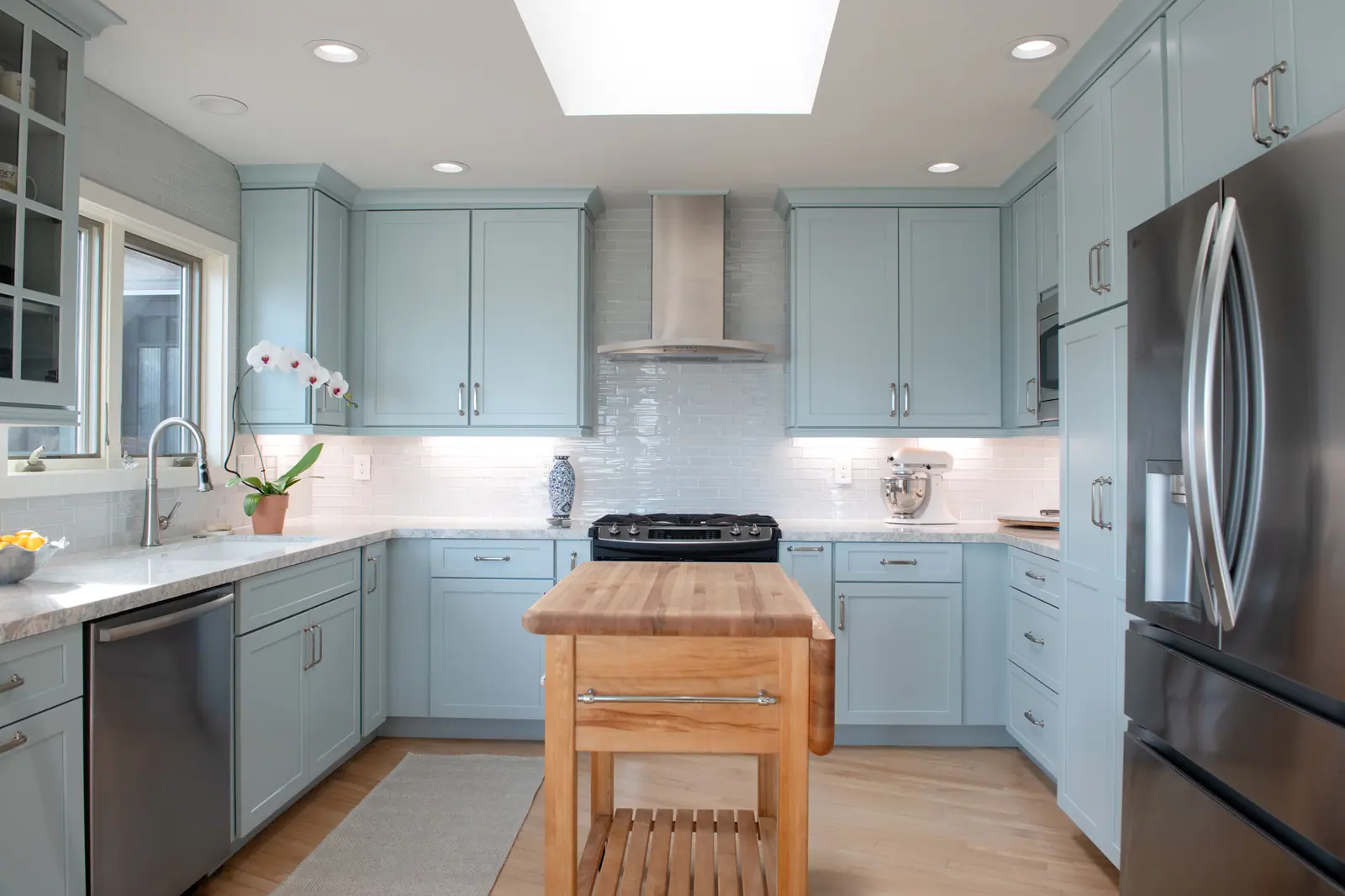
Neutrals are still the first answer for 96% of designers in the NKBA survey. The neutral itself has changed, from bright white and gray to cream and off-white. Greens follow at 83% and blues at 75%, each a few points below last year, and 54% expect the island in a color distinct from the rest of the cabinetry. MasterBrand's survey calls green the dominant accent color, and four of the eight 2027 colors of the year from the paint and stain companies are greens, from Sherwin-Williams' soft Celery to Benjamin Moore's deeper Webster Green.
The practical rule is to put color where repainting is a weekend, not a remodel: the island, a pantry interior, a hutch or a bar. The long runs stay in the cream or the wood. A green island with oak or off-white around it is the 2027 kitchen in one sentence, and it is also the version that can become a blue or a walnut island in 2037 without touching anything else.

Hidden appliances and doors instead of open shelves
The NKBA calls it "Concealment Is King": 85% of designers agree that cabinetry is being designed to hide appliances and working parts, and 64% agree that open shelving is on its way out in favor of enclosed storage. The 2026 report had already found panel-faced dishwashers gaining with 85% of professionals and panel-faced refrigeration with 72%. MasterBrand lists appliance garages and built-in waste and recycling units among the features its designers are asked for most.
In cabinet terms that is four things. A panel-ready refrigerator and dishwasher that take the same door as their neighbors. An appliance garage at counter height, with outlets inside, for the toaster, the coffee machine and the blender. A microwave in a drawer or behind a lift door. And upper cabinets that run to the ceiling with doors, keeping one open shelf or a glass-front pair for the things worth looking at. Open shelves were easy to photograph and hard to live with, especially near a range.
See these cabinets priced for your kitchen
A complimentary in-home design consultation is where a trend becomes a drawing: a designer measures the room, brings door and finish samples that suit the house, and prices two or three cabinet lines side by side so you can see what each choice costs. The kitchen calculator gives a first number in about a minute.
The inside of the box: drawers, light and the pantry wall
The quiet trend of 2027 is that the money is moving inside the cabinet. In the NKBA survey 87% of designers expect under-cabinet lighting and 76% lighting inside the cabinets, both up from a year earlier; 73% predict dedicated stations for small appliances; and when designers are asked how the island will change, storage (60%) comes right after technology. Home buyers agree: in the National Association of Home Builders' latest buyer survey, 74% rate pull-out shelves essential or desirable, level with a central island.
What that looks like in a kitchen we build: deep drawers instead of doors in nearly every base cabinet, because a drawer brings the back of the cabinet to you; full-height pull-outs beside the range for oils and spices; a pantry wall with rollouts and a counter inside; a charging drawer; and a low-voltage light strip that comes on when a door opens. In California the under-cabinet lights go on their own switch, separate from the ceiling lights, by code.
No public source measures how many kitchens get soft-close hardware or push-to-open doors, so we will not quote one. What can be checked is durability. The cabinet manufacturers' association certifies cabinets to a published standard: doors and drawers opened and closed 25,000 times, shelves loaded at 15 pounds per square foot for a week, a wall cabinet hung with 600 pounds, and finishes tested against heat, cold and a list of kitchen stains from coffee to mustard. A KCMA certification seal on a cabinet line means it passed.
What San Diego homeowners ask for when they ask about cabinets
About one in six of the written kitchen inquiries in our records mentions cabinets by name. Reading those tells us how people think about cabinets before they have met a designer.
More than half talk about countertops in the same message: for most people cabinets and counters are one decision, and they are right. About a quarter ask for new cabinets and about one in seven asks about refacing, refinishing or painting the ones they have. Fewer than one in ten names a color or a wood. The finish that fills the trend reports is, for most homeowners, a decision made later, with samples in the room.
The market behind the showroom: tariffs, sales and lead times
Three sets of numbers explain why a cabinet quote in 2027 will not look like one from 2024.
The tariff. Imported kitchen cabinets and bathroom vanities have carried a 25% tariff since October 14, 2025. Under the proclamation of December 31, 2025 it is scheduled to rise to 50% on January 1, 2027, except for countries that reach an agreement; the step was postponed once before, so we write "scheduled." Cabinets from China have carried separate antidumping duties since 2020.
The imports. Official U.S. trade statistics for wooden kitchen furniture, the customs category that is mostly cabinets, show where imported cabinets come from and what the tariff year has done.
In the first eight months of 2026 the value of those imports ran about 38% below the same months of 2025. Vietnam still supplied about four of every ten import dollars; Italy was the one large source that grew. The statistics do not say why, and we will not either, but the timing is what it is.
The sales. The Kitchen Cabinet Manufacturers Association's monthly survey of American makers shows 2026 sales down 6.0% through September and the number of cabinets down 9.6%: fewer cabinets at a higher average price. The split by type is the telling part.
Custom work is holding while the middle and the bottom of the market shrink. MasterBrand told investors in November 2026 that it sees buyers trading down to cheaper lines, that tariffs cost it roughly 5% to 6% of its 2026 sales, and that its selling prices rose with "the flow through of tariff pricing."
What to do with that. Ask where a cabinet line is built and whether the quote is before or after the duty. Domestic semi-custom lines now price much closer to imports than they did, and one large American manufacturer was quoting three to six weeks from order to delivery for its stock and semi-custom brands in October 2026. Custom cabinetry is a different clock: in our projects it runs ten to fourteen weeks from a signed order, which is why we order it the day the design is approved.
Two labels worth looking for
Trends change; two checks do not.
- The formaldehyde label. Every cabinet sold in California that contains plywood, particleboard or MDF has to be made from panels that meet the state's emission limits, which are the same numbers as the federal ones. The label, on the cabinet or its carton, names the maker and the production date and reads "TSCA Title VI compliant" or "California 93120 Phase 2 Compliant." The California Air Resources Board notes that a missing label is not proof of a problem, because the label may be on the box, so ask. Wording such as NAF or ULEF means the panels were made with no added formaldehyde or an ultra-low-emitting resin, below the standard.
- The KCMA certification. The seal described above, for durability, and the association's environmental program for the maker's practices. Neither says anything about style; both say the cabinet was tested by someone other than the salesperson.
Reface, refinish or replace
Most kitchen projects in America are small ones. Harvard's Joint Center for Housing Studies counts about 2.5 million homeowners remodeling a kitchen in 2023, and roughly three quarters of them did a minor project, averaging about $7,000, rather than a major one averaging $48,000. The industry's best-known cost survey prices a "minor kitchen remodel" in which the cabinet boxes stay and the fronts are replaced with new shaker doors and hardware, alongside new counters, appliances and flooring: in the Pacific region in 2025 it cost $29,728 and returned 129% of that at resale, the best figure of any kitchen project. That return belongs to the whole refresh, not to the new doors alone.
Refacing works when three things are true: the boxes are sound plywood or solid wood, the layout is staying exactly as it is, and the inside of the cabinets does not bother you. It does not fix a kitchen whose problem is the layout, shallow uppers or forty-year-old drawer slides, and it rules out most of the 2027 list above, the tall storage, the hidden appliances and the drawers. Our article on refinishing or replacing kitchen cabinets goes through the decision. In our own pricing, a refresh that keeps the cabinets starts around $60,000 as a complete, permitted project, and a full remodel in the same layout runs $100,000 to $150,000, with cabinetry about a third of it; the kitchen cost guide has the breakdown.
What is fading
Nearly two thirds of designers say they are on their way out. Keep one for display; put the dishes behind doors.
The painted kitchen has moved to cream and off-white, with wood beside it. Cool gray islands date a kitchen fastest.
The stainless refrigerator as a centerpiece is giving way to panels. The range and the hood are the two things still meant to be seen.
Matte and low-sheen finishes have taken over on cabinets, the same way honed finishes have on counters.
Cabinets stop at the ceiling now, with a second tier of doors for what you reach twice a year.
Drawers have replaced them almost everywhere below the counter. Nobody kneels to find a pot lid by choice.
What our designer asks before choosing a door
Andrea Short, our kitchen and bath design specialist, reviewed this article. She starts cabinet conversations somewhere other than the door sample.
How cabinet trends have changed: our 2025 cabinet trends article is still online for comparison. When you are ready to look at real doors, the kitchen remodeling page shows how we design and build them.
Download the one-page 2027 cabinet trends and buying checklist (PDF)
How we built this article
The design figures are from the NKBA 2027 Kitchen Trends Report press release (the full report is for members; where it publishes no public number, we print none) and, labeled as the prior year, its 2026 report. MasterBrand's 2027 trends release is a manufacturer's survey of its own designers and dealers and is quoted as that. Sales are from the Kitchen Cabinet Manufacturers Association's Trend of Business survey for September 2026. Import figures are official U.S. statistics for tariff heading 9403.40, with shares and changes calculated by us; they describe wooden kitchen furniture, not cabinets alone. The rules are from the Federal Register, the Code of Federal Regulations and the California Air Resources Board, read in November 2026; the tariff step can change on short notice and this page will be updated if it does. The first-party figures are the written kitchen inquiries in our records, published as shares. Prices and lead times for custom work are ours. We publish a new edition of this article each year.
Sources read for this article (November 2026)
- National Kitchen & Bath Association, "NKBA 2027 Kitchen Trends Report Signals Shifts in Kitchen Design" (October 14, 2026); "NKBA | KBIS Releases Annual 2026 Kitchen Trends Report" (September 18, 2025).
- MasterBrand, Inc., "MasterBrand, Inc. Unveils 2027 Cabinetry Trends and Finish of the Year" (September 15, 2026); third quarter 2026 results (November 5, 2026).
- Kitchen Cabinet Manufacturers Association, September 2026 Trend of Business Report (October 26, 2026); ANSI/KCMA A161.1-2022 Performance and Construction Standard for Kitchen and Vanity Cabinets; Environmental Stewardship Program.
- U.S. import statistics, HS 9403.40, wooden furniture of a kind used in the kitchen, 2024 to August 2026 (U.S. Census Bureau data as reported to UN Comtrade).
- Federal Register: Proclamation 10976 of September 29, 2025 and Proclamation 11000 of December 31, 2025; antidumping and countervailing duty orders on wooden cabinets and vanities from China (April 21, 2020).
- 40 CFR 770.10 (TSCA Title VI formaldehyde emission standards); California Air Resources Board, composite wood products regulation (17 CCR 93120) and consumer and labeling FAQs.
- Fastmarkets / Hardwood Market Report, hardwood market commentary (August 13, 2026); Illinois Department of Natural Resources, timber market report, second quarter 2026; Woodworking Network, cabinet construction and finish reporting (February 24, 2026).
- National Association of Home Builders, What Home Buyers Really Want, 2024 edition; American Institute of Architects, Home Design Trends Survey, Q1 2026.
- Journal of Light Construction, Cost vs. Value 2025, minor kitchen remodel, Pacific region; Joint Center for Housing Studies of Harvard University, Improving America's Housing 2025, table A-1.
- Cabinetworks Group, operations status page (updated October 14, 2026); Minwax, Sherwin-Williams and Benjamin Moore 2027 color announcements.
- Kaminskiy Design & Remodeling inquiry records (tools/blog_data/bath_cabinet_words.py; shares only) and 2026 kitchen pricing.
Kitchen cabinet trends 2027: your questions
Natural wood, led by white oak, with warm medium stains returning beside the light ones; creamy off-whites instead of bright white and gray; green as the accent color, usually on an island in its own finish; appliances hidden behind matching panels; doors and tall storage in place of open shelves; and more of the budget inside the cabinet, in drawers, pull-outs, pantry walls and lighting. Flat-panel and slim-rail doors in matte finishes carry most of it.
Bright white with gray is. Neutrals are still the first choice of 96% of designers in the NKBA's 2027 report, but the neutral has moved to cream and off-white, and it is usually paired with wood rather than used alone. A white kitchen with a wood island, warm hardware and a counter with some movement reads current. If your white cabinets are sound, new counters, hardware and a painted or wood island change the room more than new doors.
Yes: it is the wood of choice for 49% of designers in the NKBA's 2027 report, close to last year's 51%. It is not scarce. The hardwood industry's own price reporting in August 2026 had white oak lumber at its lowest in at least two and a half years; walnut is the species with tight supply. What costs more in an oak kitchen is the cut, usually rift, the matching of the veneers and the finishing.
Let the house and the storage decide. A flat panel suits hidden appliances, tall storage walls and newer houses; a slim-rail shaker reads cleaner than the classic one and suits most San Diego ranch and Spanish homes; the classic shaker is still the safest painted door in an older house. The NKBA's 2027 door-style figures are not public; its 2026 report had 69% of professionals naming the flat, slab door as gaining popularity. Two door styles in one kitchen works. Three does not.
Imported ones are likely to. The tariff on imported kitchen cabinets and vanities is 25% and is scheduled to rise to 50% on January 1, 2027, except for countries that reach an agreement; it was postponed once before. MasterBrand told investors in November 2026 that tariffs cost it about 5% to 6% of its 2026 sales and that its selling prices rose as that cost passed through. Domestic lines are less exposed. Ask where a cabinet line is built and whether the quote is before or after the duty.
Reface when the boxes are sound, the layout is staying exactly as it is and the inside of the cabinets works for you. Replace when the problem is the layout, shallow or short uppers, worn drawer hardware, or when you want tall storage, hidden appliances and drawers. A minor kitchen remodel that keeps the boxes and replaces the fronts, counters, appliances and floor cost $29,728 in the Pacific region in the 2025 Cost vs. Value report and returned 129% at resale, but that return belongs to the whole refresh.
It depends on the line. One large American manufacturer was quoting three to six weeks from order to delivery for its stock and semi-custom brands in October 2026. Custom cabinetry in our projects runs ten to fourteen weeks from a signed order, which is why we order it the day the design is approved and plan demolition around the delivery date.
Ready when you are