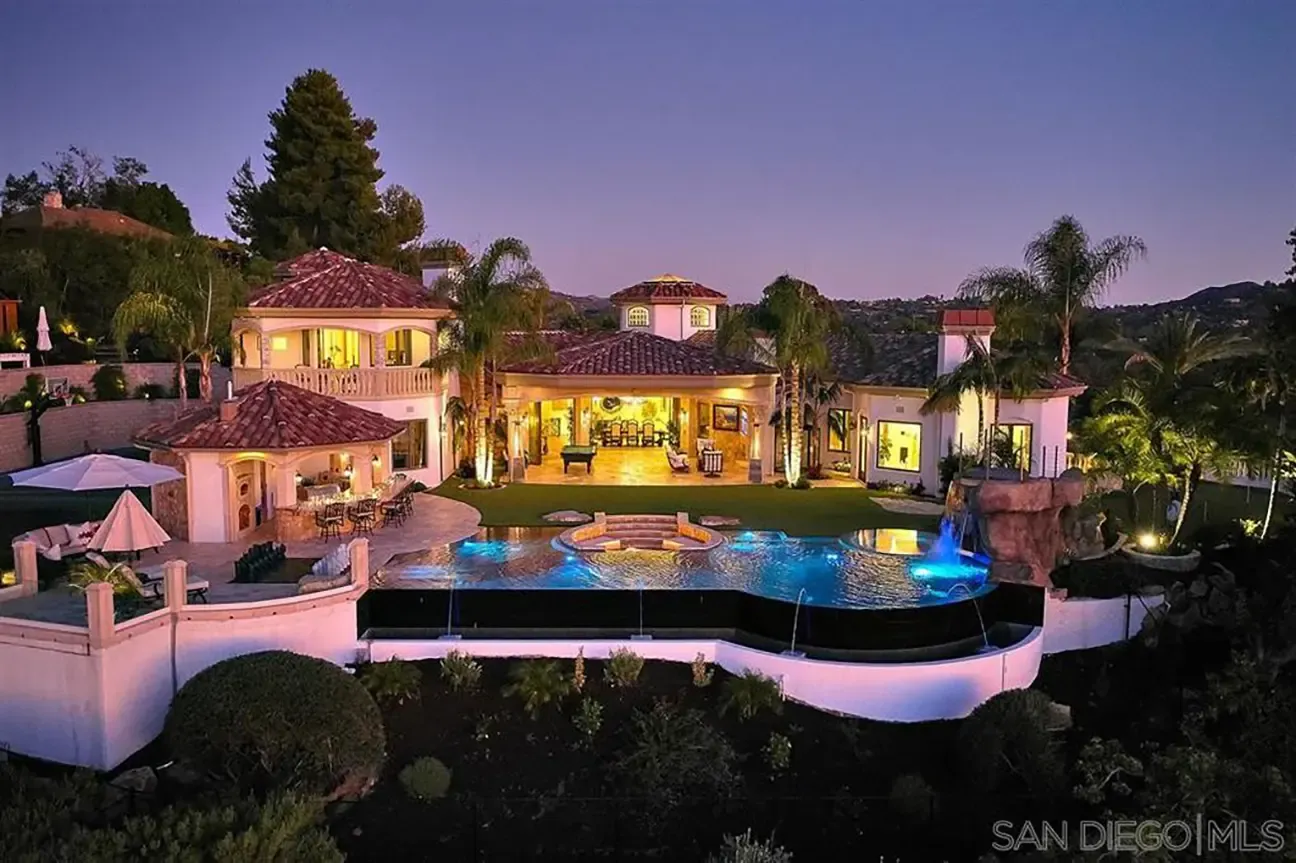


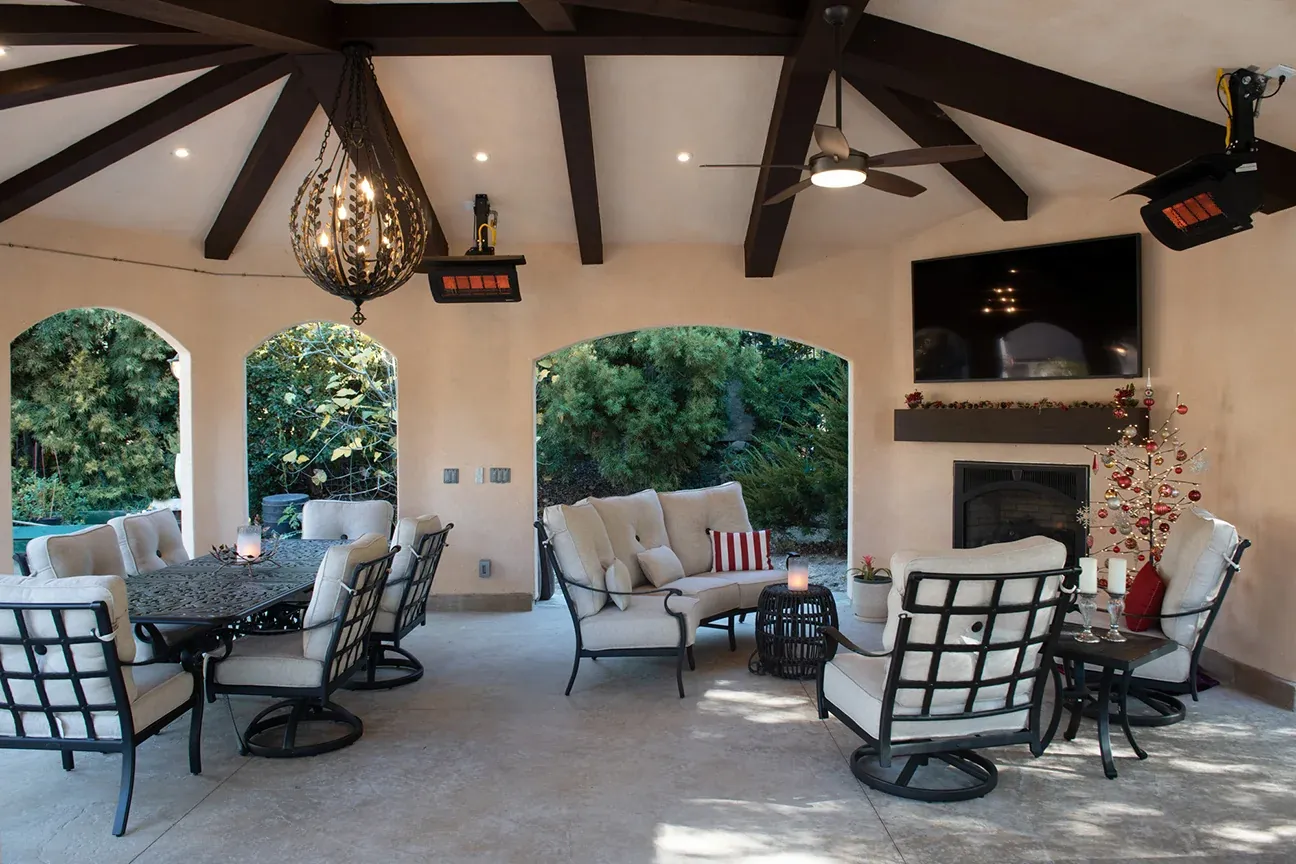


San Diego homeowners are going into 2027 improving the house they have rather than buying the next one, and the remodel itself has changed. Kitchens are being zoned instead of opened wide. Bathrooms are built around the shower. The patio has become a room with a roof, a kitchen and heat. One lot increasingly holds two households. Color and real wood have replaced white and gray. And more of the plan than ever is set by a calendar rather than by taste: a cabinet tariff scheduled to double on January 1, 2027, wildfire rules that reach existing homes in the City of San Diego on February 28, 2027, new state ADU laws, and an energy code that is now frozen in place until 2031.
This is the 2027 edition of the trends guide we publish every year. It answers three questions in order: what the market looks like going into 2027, what San Diegans are actually remodeling and why, and which ten trends are worth building into a project, each with its evidence and its San Diego price. Every figure is from a named trade, government or academic source read in November 2026, or from our own records, published as shares rather than counts.
The ten San Diego remodeling trends for 2027, in one line each:
- The planned kitchen: zones instead of one open room, wood cabinets that hide the appliances, a working pantry.
- The shower-first bathroom: a large curbless shower, a wood vanity, the tub only if it will be used.
- The outdoor room: a covered, heated, wired space that works twelve months a year.
- A second front door: an ADU, a garage conversion or a ground-floor suite for a parent, an adult child or a tenant.
- Rooms that close: an office with a door, a mudroom, a den, inside a plan that still feels open.
- Warm color and real wood: greens, browns and warm neutrals, white oak, texture instead of pattern.
- The wired house: a bigger panel, a heat pump, circuits for induction and a car, room for a battery.
- The fire-smart five feet: hardscape and metal where mulch and wood fences used to meet the house.
- Aging in place by default: no-step showers, wider doors and blocking in the walls, designed in from the start.
- One plan, built once: the kitchen, the bathrooms and the floors designed together instead of a room every few years.
The 2027 backdrop: a flat market, an older house and a mortgage nobody wants to give up
The national forecasts for 2027 agree with each other. Harvard's Joint Center for Housing Studies, in its October 2026 outlook, expects annual spending on home improvement and repair to "remain relatively flat through late 2027," at about $525 billion, with growth of 1.5% by the third quarter. The National Association of Home Builders cut its forecast for 2026 to 1% growth after inflation and kept 2027 at 2%; its remodelers' index sat at 62 in the third quarter, still positive, with the chair of its remodelers council noting that "economic uncertainty is making some potential customers hesitant." The National Kitchen & Bath Association puts it most plainly: industry spending is "increasingly being supported by higher prices rather than stronger project activity."
Three things hold remodeling up while home sales stay slow, and all three are at least as strong in San Diego as in the country as a whole.
The mortgage is the first. Selling a house with a 3% loan to buy one with a 7% loan is a decision most owners are not making; the California Association of Realtors' chief economist expects the lock-in effect to "continue to keep many potential sellers on the sidelines" through 2027, with the statewide median price forecast to rise 1.4%. San Diego County's median single-family price was $1,050,000 in September 2026, up 6.1% in a year. The house is the second: a home from the 1970s, the county's largest building decade, is on its second roof, its original plumbing and often its original electrical panel, and Harvard finds owners of pre-1980 homes spend 24% more on improvements than owners of homes built since 2010. Tenure is the third: people who stay twelve years remodel for themselves, not for a buyer.
A flat market is not a cheaper one. Building material prices rose 5.5% in the year to September 2026, the fastest since 2022. Nearly half of builders report a shortage of skilled trades, and the typical builder paid about 4% more for the same labor than a year before. The City of San Diego's plan check and inspection fees for a remodel are about 7% higher than a year ago. And the tariffs described below fall on cabinets, vanities, stone, appliances and lumber, the largest lines in most projects.
What San Diegans are remodeling, and why
Two sources of our own show what sits behind those national numbers. The first is the survey of 110 California homeowners we ran in April 2026, all planning to start construction within a year: bathrooms were the most common project (55%), kitchens next (53%) and outdoor living spaces third (31%), ahead of whole-house projects, ADUs and additions. Their biggest complaint was outdated finishes (35%), not a lack of space (15%), and their biggest worry was finding a contractor they could trust (37%), ahead of the budget (31%).
The second is what people write when they first contact us. About a third of the written inquiries in our records give a reason for the project, and the reasons are not the ones a resale-minded trend list would predict.
More space leads, an outdated house is second, and a quarter of the reasons involve a unit for rent or family. Getting a house ready to sell is the reason in about one in fifty of them. That is the lock-in effect in homeowners' own words: San Diegans are remodeling to stay. It is also why the trends below lean toward things that are lived with for a long time, the layout, the storage, the shower, the yard and the second household, more than toward finishes chosen for a listing photo.
The ten San Diego remodeling trends for 2027
1. The planned kitchen
The National Kitchen & Bath Association's 2027 Kitchen Trends Report, from a survey of 830 kitchen professionals, records a reversal: defined zones, partial walls and sliding partitions are replacing the fully open plan, and 81% of designers call zoning here to stay. White oak is the wood of choice for 49% of designers, 85% design cabinetry to hide the appliances, quartzite (78%) has moved ahead of quartz (74%) on the counters, and 88% say the pantry is becoming a working extension of the kitchen. The share expecting kitchens to keep growing fell from 76% to 52% in a year; the space is going to the pantry and the mudroom instead. Our kitchen remodeling trends guide for 2027 covers each of these, the California rules on ranges, hoods and engineered stone, and what each choice costs.
In San Diego: $100,000 to $150,000 for a full remodel in the same layout; $150,000 to $225,000 when the layout is re-zoned. Staying power: high. Layout and storage outlast every finish.
2. The shower-first bathroom
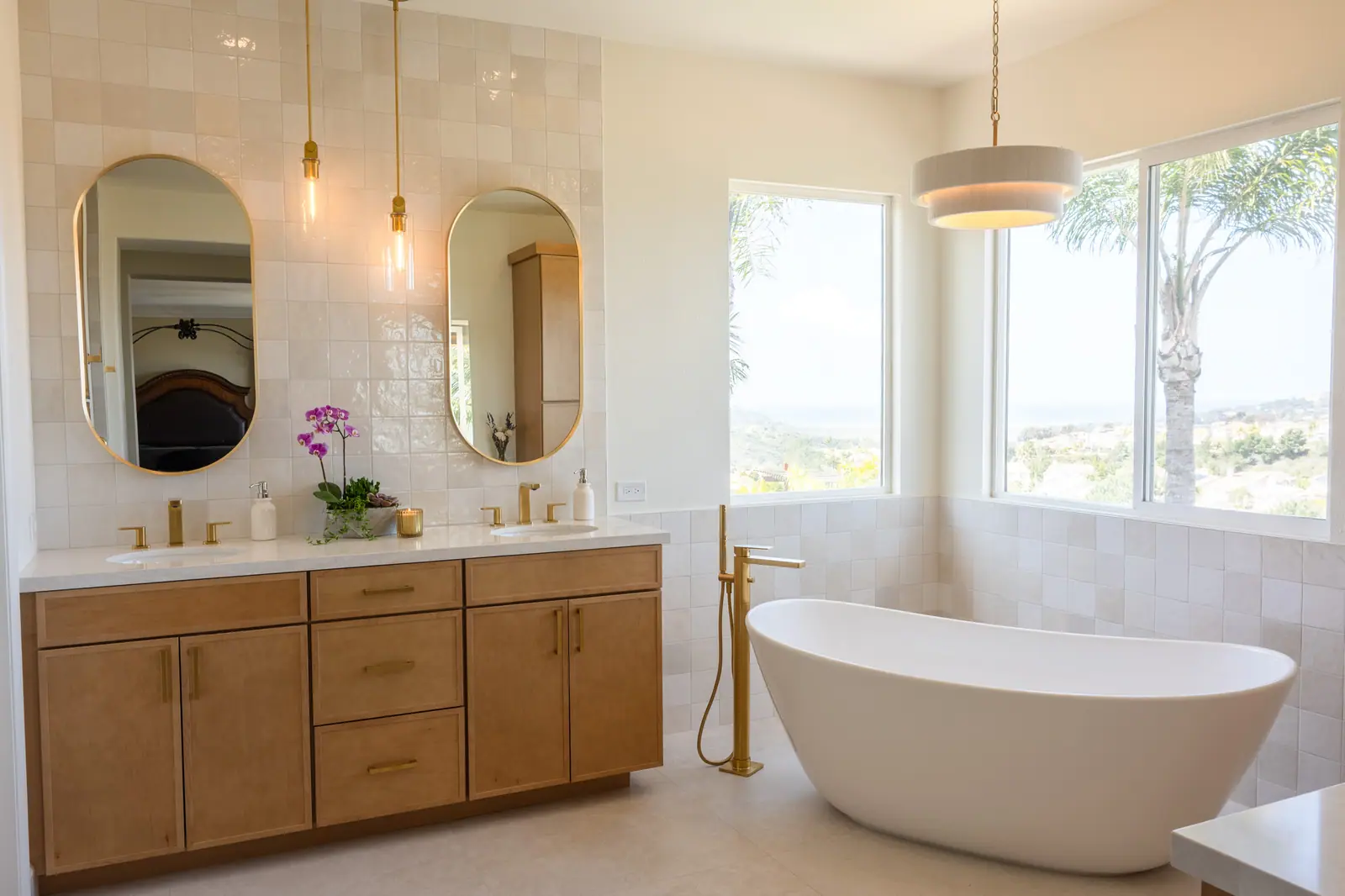
The bathroom has changed more than any room in the house. In the NKBA's most recent bath report, published in November 2025 from nearly 700 professionals, 55% say clients now choose a larger shower over a bathtub, 72% expect the bath footprint to grow, 77% expect hotel and spa cues, and wood-faced vanities (62%) have overtaken painted ones (53%); the association's 2027 bath report had not been released when this guide was updated. Architects in the AIA's survey name stall showers without tubs the top bathroom feature. In our projects that is a wet room or close to it: a curbless shower with a linear drain, a bench and a handheld spray, slab or large-format walls with few grout lines, a wood vanity, a lit mirror and a heated floor, with the freestanding tub kept only when someone will use it.
In San Diego: $55,000 to $85,000 for a full bathroom in the same layout; $75,000 to $115,000 and up for a spa-level primary bath. Staying power: high. A good shower is used every day for twenty years.
3. The outdoor room
Outdoor living is the single most requested special-function room in the AIA's 2026 survey of residential architects, named first by 20% of them, and the net share reporting rising demand went from 40% to 51% in a year. Everywhere else that is a trend. In San Diego it is the room with the best weather in the house. What has changed is how finished it is: a California room or covered patio with a real ceiling, lighting, heaters and a fan; an outdoor kitchen with gas, power and a sink planned on the same drawing as the indoor one; a fire feature; and a wall of glass that makes the two rooms one. One rule to know before choosing a pool or spa heater: under the 2025 Energy Code a new primary heater has to be a heat pump, solar, or mostly renewable, with limited exceptions.

In San Diego: $40,000 to $120,000 for a California room or covered patio; $30,000 to $100,000 for an outdoor kitchen; $100,000 to $300,000 when several pieces share one plan. Staying power: high here, because the season is all year.
4. A second front door
More households are sharing a lot. The Pew Research Center counts 22% of Americans living in a home with more than one adult generation in 2024, up from 16% in 2000; 14% of buyers in the Realtors' 2026 survey bought a multigenerational home; and architects report accommodations for multiple generations (net 53% rising) and first-floor primary suites (52%) at the top of the feature list. In our own inquiries, a unit for rent or for family is part of about a quarter of the stated reasons to remodel, and a parent or relative moving in is one in twelve.
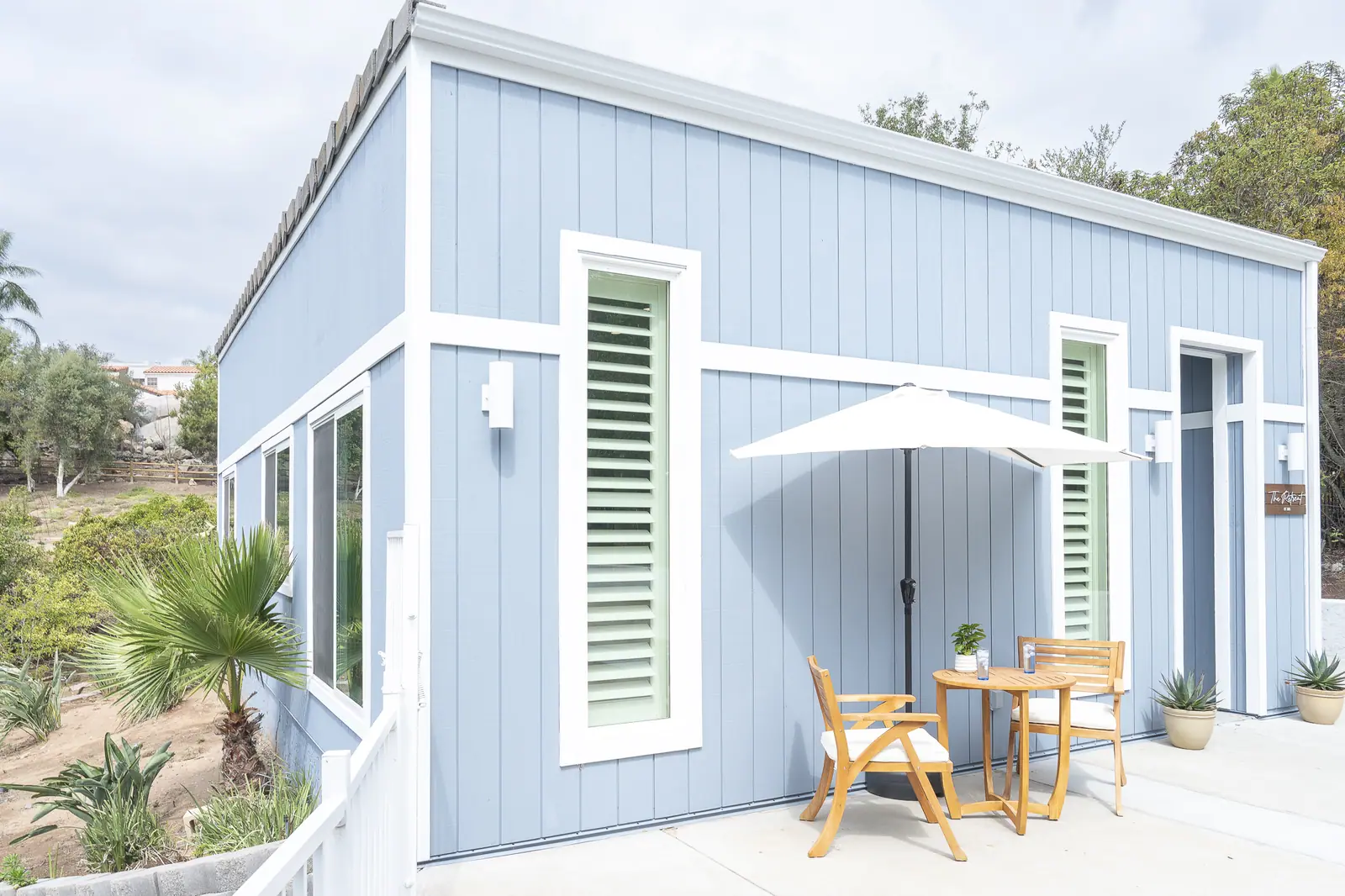
California keeps making the second unit easier, and two laws signed in September 2026 take effect on January 1, 2027. Assembly Bill 956 raises the number of detached, new-construction ADUs a city must approve by right on a single-family lot from one to two. Senate Bill 1117 limits impact fees on an ADU larger than 750 square feet to the area above 750, for up to two units on a lot; smaller units already pay none. The City of San Diego moved the other way on its own bonus program in 2025, capping bonus ADUs by lot size and limiting the program in the lowest-density single-family zones, so the state rules are now the ones that matter for a typical lot.
In San Diego: $140,000 to $180,000 for a garage conversion; $600 to $650 per square foot plus about $80,000 for the kitchen and bath for a detached unit of 400 to 700 square feet; about $300,000 for a 500 square foot ground-floor addition with a bathroom. Staying power: high. It is the only trend on this list that can pay rent.
5. Rooms that close
The open plan is being edited, not abandoned. Beyond the kitchen, architects name flexible multi-use rooms (16%), home offices (15%) and mud rooms (15%) right behind outdoor living as the most popular special-function rooms, and 94% of designers in the NKBA's 2027 report expect mudrooms attached to the kitchen. What ties them together is a door.
The home office is the clearest case. What is trending for home offices in San Diego is less about furniture than about construction: a room that closes, with sound insulation in the wall it shares with the family room; a built-in desk wall with storage and its own circuits; daylight from the side rather than behind the screen; and, when the house has no room to give, a backyard office or an ADU that doubles as one. Architects report demand for home offices still rising but more slowly than a year ago (net 24%, from 30%), which fits what we see: the pandemic office in the guest room is being replaced by a smaller, better one, or folded into a flexible room that is also the guest room.
Staying power: high. A door is cheap when the framing is open and expensive afterward.
6. Warm color and real wood
Gray is gone from every forecast. In the NKBA's 2027 report neutrals still lead at 96%, but they are warm ones, and greens follow at 83%. Of the eight 2027 colors of the year announced by early November 2026, four are greens or close to it: Benjamin Moore's Webster Green, Sherwin-Williams' Celery, Behr's olive Grounded and Glidden's aqua Artifact. The others are a warm blue-gray from Valspar, a deep brown from Dunn-Edwards, an earthy orange from Dutch Boy and, from Minwax, a light stain called Pickled Oak, which is the wood half of the story: white oak is the cabinet wood of choice for half of designers, and wood vanities have passed painted ones.
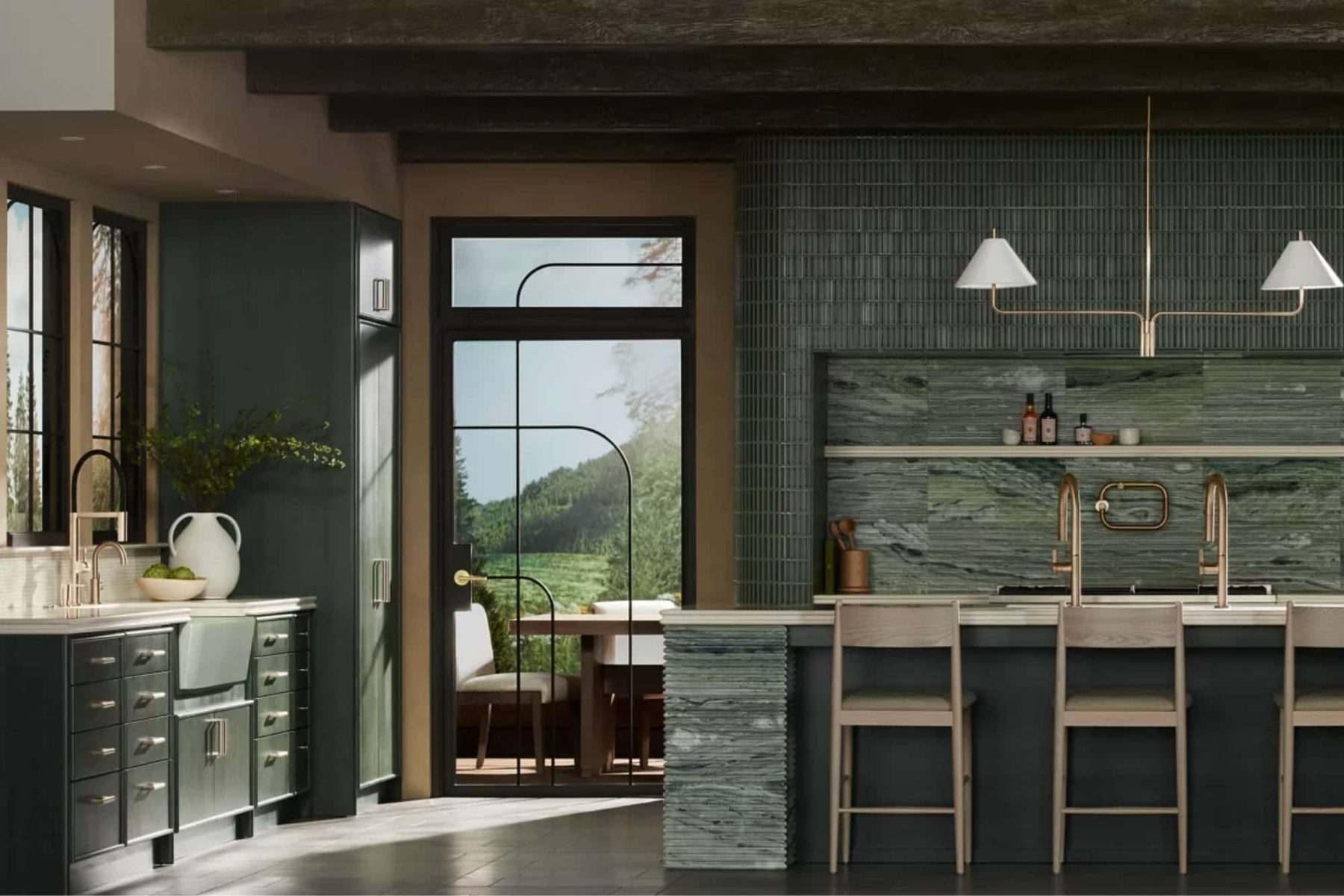
In our projects the palette arrives three ways. Color drenching, one hue on walls, trim and often the ceiling, which suits a den, a dining room or a powder bath. Texture in place of pattern: limewash and plaster walls, fluted and reeded cabinet faces, handmade-look tile in soft whites. And wood used like furniture: an oak island, a walnut vanity, a paneled wall. Near the coast the whites go sun-washed and the greens go sea-glass, and exterior finishes are chosen for salt air.
Staying power: mixed, on purpose. Put the color where it is easy to change, on paint and the island, and keep stone, floors and wood in the warm neutral range.
7. The wired house
Electric car charging is the most-cited technology in the AIA's survey, with a net 77% of architects reporting rising demand, and designers in the NKBA's report now expect backup power (62%) and leak detection with automatic shut-off (65%) as resilience features. California's code points the same direction. The 2025 Energy Code, which applies to permits filed since January 1, 2026, makes the heat pump the baseline for space heating in every climate zone, removes gas tankless water heaters from the standard options for additions, and sets a window U-factor of 0.30 for San Diego's climate zones on the standard compliance path.
Three facts keep this honest. The code does not require a remodel to be wired for future electric appliances; the Energy Commission's manual says its electric-ready rules apply to newly built homes, not to additions or alterations. The money that used to help is gone: the federal tax credits for efficient equipment, solar and batteries ended for work completed after December 31, 2025, and California's federally funded heat pump rebates for single-family homes were fully reserved in February 2026. And electricity here is expensive, an average of 45.5 cents a kilowatt-hour for San Diego Gas & Electric's residential customers in mid-2026, the highest of the state's three large utilities, which is why solar and a battery stay in the conversation even without the credit.
So the trend is not electrify everything. It is electrify the things that are open: a 200-amp panel while the walls are open, a 240-volt circuit behind the range and in the garage, a heat pump when the furnace or water heater is due anyway, and a place on the wall for a battery. Each costs a fraction during a remodel of what it costs alone. One more fact makes the planning easier: a state law passed in 2025 freezes residential building standards from October 2025 until June 1, 2031, with narrow exceptions such as wildfire home hardening, so the code a 2027 remodel is designed to is the code for the next four years.
Staying power: high. Nobody has regretted a bigger panel.
8. The fire-smart five feet
Zone 0 is the first five feet around a house, where embers do most of their damage. About two thirds of the City of San Diego's land lies in a Very High Fire Hazard Severity Zone, and the City has its own schedule, published in its wildfire prevention guidance:
- New structures: since February 28, 2026, any new structure applying for a building permit in those zones follows the Zone 0 guidelines.
- Existing homes: the rules begin to apply on February 28, 2027 and phase in over three years. The first year is maintenance: clearing dead vegetation and debris and moving firewood, bins and stored items away from the house. Vegetation changes follow from February 2028, and full compliance, including fences and gates, from February 28, 2029. The City describes 2027 as a year of voluntary compliance.
- What is not required: the City's guidelines say they "do not require home hardening retrofits," and attached decks, balconies and stairs do not have to be replaced. An existing wood fence or gate that meets the house needs a five-foot non-combustible section where it attaches.
The statewide regulation is still not final. The Board of Forestry and Fire Protection approved its text in August 2026, withdrew it for edits and planned to resubmit it in mid-November 2026; as proposed, it gives existing homes about three years from its effective date for most requirements. For anyone remodeling in Scripps Ranch, Rancho Bernardo, Del Cerro, Tierrasanta or the east county, the design consequence is the same either way: gravel, pavers or bare soil in the first five feet instead of mulch, no plants over 18 inches against the wall, non-combustible pots, a metal gate where the fence meets the house, and new trees planted well clear of the roof line. Done as part of a landscape or exterior project, it costs little and it looks deliberate.
Staying power: permanent. This one is a rule, not a taste.
9. Aging in place by default
Residents 65 and over are 17.5% of San Diego County, and three quarters of Americans over 50 tell AARP they want to stay in the home they have. Owners 65 and older already account for 27% of all home improvement spending, up from 14% two decades earlier, according to Harvard. Remodelers surveyed by the home builders' association report the same three jobs most often: grab bars, curbless showers and taller toilets. And architects report first-floor primary suites and wider doorways and hallways among the fastest-rising features in the house.
The change for 2027 is that these details are no longer a separate project for a later decade. A curbless shower, a bench, a handheld spray on a slide bar, a 36-inch door and plywood blocking behind the tile for future grab bars add a few thousand dollars to a bathroom that is being rebuilt anyway and tens of thousands to one that is not. Our aging-in-place cost guide prices each of them.
In San Diego: $30,000 to $45,000 to turn a tub into a curbless shower; $55,000 to $90,000 for a full universal design bathroom. Staying power: it is the definition of it.
10. One plan, built once
The last trend is about scope. More than half of the members of the National Association of the Remodeling Industry reported larger project scopes over the previous two years in the Realtors' latest remodeling report, and our own records show the same shift: about six in ten of the kitchen proposals we priced in 2022 and 2023 included another room or an addition, up from under half in 2021, and four in ten written kitchen inquiries name a bathroom in the same message. People who are staying twelve years are doing the kitchen, the bathrooms and the floors as one design, with one permit set and one crew, even when the construction is phased.
In San Diego: $200 to $250 per square foot inside the walls, or $360,000 to $600,000 for most whole home remodels. Staying power: high. A house designed once reads as one house.
What architects report clients asking for
The clearest single picture of where homes are going is the American Institute of Architects' quarterly survey of residential firms, which asks whether each feature is becoming more or less popular with clients. Its 2026 home features edition is the source for several numbers above, and it reads like a San Diego wish list.
Want to see these ideas in your own floor plan?
A complimentary in-home design consultation is where a trends list becomes your list: a designer walks the house, hears how you live and comes back with a concept and a range that fit the architecture you have. Our before-and-after galleries show each of these ideas in a finished San Diego home.
The 2027 calendar: dates that change a San Diego remodel
No national trends list has this section, and for planning it may be the most useful one. These are the dated changes we are designing around.
| Date | What changes | What it means for a project |
|---|---|---|
| January 1, 2027 | The tariff on imported kitchen cabinets and bathroom vanities is scheduled to rise from 25% to 50%, and on upholstered wood furniture from 25% to 30%. The step was postponed once, on December 31, 2025. | Ask where a cabinet line is built and whether a quote is before or after the duty. Domestic lines are less exposed. |
| January 1, 2027 | Assembly Bill 956 and Senate Bill 1117 take effect: two detached ADUs by right on a single-family lot, and impact fees only on the part of an ADU above 750 square feet. | A second detached unit becomes possible on lots that have the room. |
| 2027 | The San Diego County Water Authority's wholesale water rate rises 3%, the smallest increase in years. | Smart irrigation and low-water planting keep paying back. |
| February 28, 2027 | The City of San Diego's Zone 0 rules begin applying to existing homes in very high fire hazard zones, phased to February 28, 2029. | Plan the first five feet around the house as hardscape in any exterior or landscape project. |
| August 15, 2027 | The federal safeguard tariff on imported quartz countertops, in place since August 15, 2026, enters its second year at 23% within quota and 49% above it. | Quartzite, granite, marble and porcelain are outside it. |
| December 31, 2027 | The reduced 15% metals tariff category that covers residential heating and cooling equipment is set to expire. | One more reason to replace an aging system during a 2027 remodel rather than after it. |
| Not yet dated | The statewide Zone 0 regulation and California's draft rule on high-silica engineered stone are both pending. | We update this page when either becomes final. |
| June 1, 2031 | The state's pause on new residential building standards ends. | Until then, the 2025 codes are the codes, with narrow exceptions. |
What each trend costs in San Diego
A trend without a price is a picture. These are the 2026 ranges from our own cost guides, each a complete, permitted project designed and built by one team; the guides carry the breakdowns, the permit paths and the history.
| Trend | The project | 2026 range | Full guide |
|---|---|---|---|
| The planned kitchen | Full remodel, same layout; or layout re-zoned | $100,000 to $150,000; $150,000 to $225,000 | Kitchen cost |
| The shower-first bathroom | Full bathroom, same layout; spa-level primary bath | $55,000 to $85,000; $75,000 to $115,000 and up | Bathroom cost |
| The outdoor room | California room or covered patio; outdoor kitchen | $40,000 to $120,000; $30,000 to $100,000 | Outdoor living cost |
| A second front door | Garage conversion; detached ADU of 400 to 700 square feet | $140,000 to $180,000; $600 to $650 per square foot plus about $80,000 | ADU cost |
| More house | Room addition; 500 square feet on the ground floor with a bathroom | $350 to $650 per square foot; about $300,000 | Addition cost |
| Aging in place | Tub to curbless shower; full universal design bathroom | $30,000 to $45,000; $55,000 to $90,000 | Aging-in-place cost |
| One plan, built once | Whole home remodel inside the walls, 1,800 to 2,400 square feet | $200 to $250 per square foot; $360,000 to $600,000 | Whole home cost |
Download the one-page 2027 trends, dates and costs summary (PDF)
What is out
Gray floors, gray islands and the cool white that went with them. Warm whites, greens, browns and real wood replaced them.
One big room gave way to open sightlines with zones, a pantry for the mess and rooms with doors.
A jetted tub in the corner and a small shower beside it. The space and the money now go to the shower.
With owners staying a record twelve years, the brief is how the family lives, not what a buyer might like.
The federal credits ended in 2025 and the state rebates are spoken for. A 2027 budget should stand without them.
In the fire zones the first five feet are hardscape, and the fence that touches the wall becomes metal.
What our designers are building, and what I expect from 2027
Anastasia Berta, our Certified Kitchen and Bath Designer and Certified Aging-in-Place Specialist, reviewed this guide. Jean Becker, our lead designer, leads the studio's conversations about color and materials. Her list for 2027 is texture on texture in warm palettes, color drenching, warmer woods, curved islands and arched openings, layered low-voltage lighting, and ceilings treated as a feature with beams and shallow coffers.
My own read, after more than twenty years of running this company and one more fall of forecasts, is that every outlook for 2027 says the same thing in different words: the market is flat and the houses are old. Harvard expects spending to sit around $525 billion, half of San Diego's homes were built before 1980, and half the country's mortgages are under four percent. Put those together and you get the homeowner we meet every week: someone who is not moving, who has decided the house they own is the house they are keeping, and who wants it done once and done properly. I do not see that changing in 2027. What I do see changing is how much of a remodel is decided by a calendar, the tariff dates and the fire rules, rather than by taste.
How to use a trends list
A trend is a reason to look, not a reason to buy. The rule we use is in our guide to balancing trends and timeless design: spend the permanent money, on layout, windows and doors, cabinets, stone and floors, on choices that will read well in fifteen years, and spend the changeable money, on paint, lighting, hardware and textiles, on what you love this year. Let the house lead: a 1960s ranch in Clairemont and a Spanish revival in Kensington want different versions of everything on this page. And use the calendar. Design takes two to four months before construction starts, so a project meant for 2027 is being drawn now, and the decisions with dates on them, the cabinet line, the stone, the first five feet outside, are the ones to settle first.
How trends have changed: 2025, 2024, 2023, 2022.
How we built this guide
The market figures are from Harvard's Joint Center for Housing Studies, the National Association of Home Builders, the National Association of Realtors, the California Association of Realtors, the Federal Housing Finance Agency, Freddie Mac and the Census Bureau's 2025 American Community Survey. The design figures are from the NKBA's 2027 Kitchen Trends Report and its most recent bath report, the AIA Home Design Trends Survey and the paint companies' own color announcements. The rules are from the Federal Register, the California Energy Commission, the California Building Standards Commission, the Board of Forestry and Fire Protection, the state's legislative information site and the City of San Diego, each read in November 2026; where a rule is still pending we say so. The first-party figures are our April 2026 survey of 110 California homeowners and our own inquiry and proposal records, published as shares; the counts stay with us. Prices are our 2026 pricing from the cost guides linked above. We publish a new edition each year and update this one when a date on the calendar moves.
Sources read for this guide (November 2026)
- Joint Center for Housing Studies of Harvard University, Leading Indicator of Remodeling Activity, "Remodeling Spending Continues to Stagnate" (October 22, 2026); Improving America's Housing 2025.
- National Association of Home Builders: Remodeling Market Index, third quarter 2026 (October 8, 2026); Mid-Year Remodeling Forecast Update (July 28, 2026); age of owner-occupied homes (March 2026); building material prices (October 15, 2026); labor shortages (October 14, 2026).
- Federal Housing Finance Agency, National Mortgage Database, outstanding mortgage statistics, second quarter 2026; Freddie Mac Primary Mortgage Market Survey, November 5, 2026.
- National Association of Realtors, 2026 Profile of Home Buyers and Sellers (November 5, 2026); 2025 Remodeling Impact Report with the National Association of the Remodeling Industry. California Association of Realtors, 2027 California Housing Market Forecast (October 7, 2026) and September 2026 home sales and price report.
- U.S. Census Bureau, American Community Survey 2025 one-year estimates, San Diego County and City of San Diego (tables DP04, DP05, B25035, B25036). Pew Research Center, "The United States at 250" (March 25, 2026). AARP, 2024 Home and Community Preferences Survey.
- National Kitchen & Bath Association, 2027 Kitchen Trends Report press release (October 14, 2026); 2026 Bath Trends Report (November 2025); 2026 Kitchen & Bath Industry Outlook, Mid-Year Update (July 21, 2026).
- American Institute of Architects, Home Design Trends Survey: Q1 2026 (kitchens and baths) and Q3 2026 (home features).
- Benjamin Moore, Sherwin-Williams, Behr, Glidden, Valspar, Dunn-Edwards, Dutch Boy and Minwax, 2027 color of the year announcements (August to October 2026).
- Federal Register: Proclamation 11000 of December 31, 2025 (timber, lumber, kitchen cabinets and vanities); Proclamation 11051 of July 31, 2026 (quartz surface products); Proclamation 11032 of June 1, 2026 (aluminum, steel and copper).
- California Energy Commission, 2025 Building Energy Efficiency Standards: single-family fact sheet and compliance manual. California Building Standards Commission, Information Bulletin 25-03 (Assembly Bill 130). Internal Revenue Service, Fact Sheet 2025-05. California Public Advocates Office, Q2 2026 Electric Rates Report.
- California Legislative Information: Assembly Bill 956 and Senate Bill 1117 (Statutes of 2026). City of San Diego: Fire-Rescue wildfire prevention page and Zone 0 Guidelines for Existing Structures (revised April 22, 2026); Development Services regulatory updates and Information Bulletin 501 (August 2026). Board of Forestry and Fire Protection, Zone 0 rulemaking materials (November 2026). San Diego County Water Authority, 2027 wholesale rates (June 25, 2026).
- Kaminskiy Design & Remodeling: California Home Remodel Survey 2026 (110 homeowners, April 14 and 15, 2026); inquiry and proposal records (tools/blog_data/trends_2027.py; shares only); 2026 pricing.
San Diego remodeling trends 2027: your questions
Ten: kitchens zoned into work areas instead of opened into one room, with wood cabinets that hide the appliances; bathrooms built around a large curbless shower; outdoor rooms with a roof, heat and a kitchen; ADUs, garage conversions and ground-floor suites for family or rent; rooms that close, such as an office or a mudroom; warm color, greens and white oak instead of gray; a bigger electrical panel and circuits for a heat pump, induction and a car; hardscape in the first five feet around the house in fire zones; aging-in-place details designed in from the start; and one plan for the whole house rather than a room at a time.
For most owners who plan to stay, yes. Harvard's Joint Center for Housing Studies expects national remodeling spending to stay flat at about $525 billion through late 2027, so good firms are available, but prices are not falling: building materials rose 5.5% in the year to September 2026, labor about 4%, and the City of San Diego's permit fees about 7%. Half of all mortgages are under 4% while a new loan is above 7%, and the county's median home price was $1,050,000 in September 2026, so improving the house you own usually costs less than replacing it.
The evidence points to modestly more, for specific reasons. The tariff on imported kitchen cabinets and bathroom vanities is scheduled to rise from 25% to 50% on January 1, 2027; imported quartz countertops have carried a new tariff since August 2026; most imported major appliances are taxed at 25% of their full value; softwood lumber carries a 10% duty; and materials, labor and City fees all rose in 2026. The National Kitchen & Bath Association describes industry spending as supported by higher prices rather than more projects.
Zone 0 is the first five feet around a house. In the City of San Diego it has applied to new structures in Very High Fire Hazard Severity Zones since February 28, 2026, and it begins applying to existing homes in those zones on February 28, 2027, phased over three years: maintenance first, vegetation changes from 2028 and full compliance, including fences and gates, by February 28, 2029. The City's guidelines do not require home hardening retrofits, and attached decks do not have to be replaced. The statewide regulation was still pending in November 2026. In design terms: hardscape instead of mulch against the house, low plants, and a metal section where a fence meets the wall.
Two laws signed in September 2026 take effect on January 1, 2027. Assembly Bill 956 requires cities to approve two detached, new-construction ADUs by right on a lot with a single-family home, up from one. Senate Bill 1117 limits impact fees on an ADU larger than 750 square feet to the area above 750 square feet, for up to two ADUs on a lot; units of 750 square feet or less already pay no impact fees. In San Diego a garage conversion runs $140,000 to $180,000 and a detached unit $600 to $650 per square foot plus about $80,000 for its kitchen and bath.
Not the ones most people remember. The federal credits for efficient home improvements and for solar and batteries ended for work completed after December 31, 2025. California's federally funded heat pump rebates for single-family homes were fully reserved in February 2026, and a second phase has no date. Plan a 2027 budget without them. The reasons to electrify during a remodel are practical: the walls are open, the panel is being replaced anyway, and San Diego's electricity, at about 45 cents a kilowatt-hour, rewards efficient equipment.
Warm neutrals and green. Designers in the NKBA's 2027 report name neutrals (96%) and greens (83%) as the leading colors, and four of the eight 2027 colors of the year announced so far are greens: Benjamin Moore's Webster Green, Sherwin-Williams' Celery, Behr's Grounded and Glidden's Artifact. White oak is the leading cabinet wood. The style behind them is warm and textured rather than white and gray: plaster and limewash walls, handmade-look tile, wood used like furniture, and one color carried across walls and trim.
A real room instead of a corner. Architects rank home offices among the three most requested special-purpose rooms, and the current version is built rather than furnished: a door that closes, sound insulation in the shared wall, a built-in desk wall with storage and dedicated circuits, daylight from the side of the screen, and good lighting for video calls. Where the house has no room to spare, a backyard office or an ADU that doubles as one is the San Diego answer, and many families now ask for a flexible room that is an office on weekdays and a guest room on weekends.
Ready when you are